
2024 was the year of market viability for EV charging networks. The U.S. saw a healthy rise in new charging stations quarter after quarter, driven largely by IRA funding and increased demand. For the first time, charging stations started turning a profit, and DC fast charging became profitable for retailers and grocery stores.
This growth is promising as the industry looks ahead to the new year. Dan Munford, CEO of leading mobility research firm Insight Research, spoke with Driivz and noted continued EV adoption in the year ahead, even if it may occur at different speeds around the globe.
“In many geographies, we will see markets and even regions moving at different rates of EV adoption and making different levels of investment and strategic change: Asian markets will see continued fast adoption and investment while most of the US and parts of Europe will move at a slower pace. Even within markets like the US, we will continue to see big differences between California and other states. Likewise, we will see big differences within Europe, with continued rapid adoption in the Nordics.”
As we near 2025, we look at five predictions about EV charging that will become a reality as EV adoption continues globally.
Widespread Adoption of AI & Predictive Analytics
AI algorithms analyze real-time data to optimize EV charging networks, balance grid demand, and improve the driver experience. AI will be instrumental in enhancing operations, reducing energy costs, maintaining charging equipment, improving grid reliability, and more. Here are the major ways AI will revolutionize EV charging in 2025 and beyond:
- Predictive charger maintenance. AI enhances predictive maintenance by analyzing system and sensor data in individual chargers to identify anomalies, predict equipment wear, and create customized maintenance schedules. With these valuable insights, CPOs can reduce downtime and extend equipment longevity.
- Dynamic pricing models and optimized utilization rates. AI analyzes energy demand, grid generation capacity, and user behavior to create optimal charging schedules to reduce costs and charging times. AI can use load demand forecasts to inform pricing models, reduce congestion at charging stations, and decrease grid stress. AI-enabled EV charging optimization also incentivizes off-peak charging behavior, helping to improve energy affordability for EV drivers while supporting grid resilience.
- Load balancing and grid integration. AI enables EVs to interplay as dynamic load balancers that respond in real-time to grid conditions, energy supply, and demand forecasts to mitigate grid imbalances.
- Personalized charging schedules via machine learning. Predictive AI analyzes customer insights, grid conditions, weather, traffic, and more to optimize each driver’s charging schedule, empowering drivers to effortlessly monitor sessions and set personalized preferences. Behind the scenes, machine learning algorithms forecast user behavior, delivering valuable long-term insights and continuously improving the charging process by dynamically integrating real-time data on charging conditions, preferences, and load demand.
- Data-driven insights for better customer engagement and operational efficiency. AI analyzes historical data, real-time weather, grid conditions, and customer preferences and habits. CPOs can make informed decisions, enhance operational efficiency, prevent congestion, and better manage peak demand utilizing these data points. Granular data unlocks game-changing insights into customer loyalty, while the operational benefits enable CPOs to streamline processes, reduce downtime, and optimize energy use.

Fleets Will Continue to Go Electric
A recent RMI analysis found that in most cases, the total cost of ownership of electric fleet vehicles is cheaper or at price parity with internal combustion engine (ICE) counterparts. As more companies move away from ICE vehicles in 2025 and beyond, we’ll see an accelerated deployment of electric fleets and an increase in technology for fleet charging optimization.
- Scalable solutions for large EV fleet charging. Smart EV charging and energy management solutions solve multiple pain points facing large fleets:
- Optimal use of private and public charging infrastructure
- Route planning incorporating EV charging and efficient delivery schedules based on ToU rates, charger availability, business priorities, and other factors
- Optimized charging schedules balance load supply while predictive maintenance drives down the upfront costs associated with fleet electrification
- Support for fleet-specific use cases. Fleets that electrify in 2025 need to provide drivers with the flexibility to charge wherever they go. By incorporating flexible billing into fleet charging technology, companies can compensate drivers for charging at home or public chargers, ensuring vehicles are always topped wherever they go.
- Integration with logistics and telematics platforms. We’ll see a synergy between fleet telematics and facilities management systems to optimize EV charging and proactively address potential equipment failures before they happen. By integrating with existing fleet management platforms, fleet operators will be able to manage energy for EV charging with limited on-site capacity and prioritize EV charging according to business needs, driver experience, and more.
Advanced Energy Management and Renewable Energy Integration at Charging Sites
Charging infrastructure is increasingly being integrated with renewable energy and battery storage systems. In 2025, EVs are poised to offer huge value-added benefits to grid stability, especially when solving for renewable energy intermittency:
- Solar and wind-powered charging sites. Integrating renewable energy generation with charging stations dramatically improves efficiency by creating a direct link between renewable generation and the charge port, saving the time and energy lost to transmission and voltage regulation. Coupled with fast chargers and renewable energy generation, next-gen charging stations will offer a sustainable EV charging solution providing the speed and reliability of service motorists have come to expect from fueling stations.
- Second-life EV batteries in charging infrastructure. If all the critical minerals were recovered from end-of-life EVs, economic savings could be as high as $25bn a year by 2040 and prevent approximately 16 megatons of CO2 emissions annually. Increasingly, we’re seeing facility-scale and even utility-scale deployment of repurposed, second-life EV batteries in energy storage systems (BESS). When paired with onsite renewable energy generation and EV charging stations, smart energy solutions for battery storage can decrease energy costs, increase revenue, and establish energy resilience.
- Vehicle-to-Grid (V2G). An estimated 85 million EVs will be on the road at the end of 2025. By acting as “batteries on wheels,” EVs and facilities equipped with bidirectional charging capabilities can receive renewable energy generated during off-peak hours and offload that energy at peak-demand periods, improving grid resilience and reliability.
Enhanced Collaboration Between OEMs and Third-Party Partners
Continued efforts to standardize protocols and equipment will create a streamlined user experience driving increased EV adoption:
- Bundle Offer for Drivers. Automakers and charging networks are bundling EVs with exclusive charging packages for convenience. For example, we will see more automakers offer free charging promotions with the purchase of an electric vehicle.
- Industry partnerships and other pre-competitive joint ventures designed to break barriers to EV adoption were announced last year. For example, Ford and SK Innovation have invested $11.4 billion into three U.S.-based battery plants to improve U.S.-based battery production capacity. With help from federal funding, a group of automakers plan to install 30,000 fast chargers along U.S. and Canadian highway corridors through 2030. Automakers’ direct investments in EV charging partnerships promote broader EV adoption, a win-win for OEMs, third-party partners, and drivers alike. This trend – direct investments that bring different industry subsections together – should continue in 2025.
Continued Evolution of EV Charging Hubs
As EV adoption continues, charging hubs will continue to look different. CEO Dan Munford at Insight Research shares his prediction with Driivz on what the industry can expect in terms of new EV charging formats in the year ahead:
“Roadside retail formats like gas stations, motorway/highway services, and drive-thrus are actually quite long-established retail solutions and the promise of EV Hubs has always been that this was an opportunity for the creation of a genuinely new format which allowed a new, contemporary approach to be taken in terms of design and purpose.
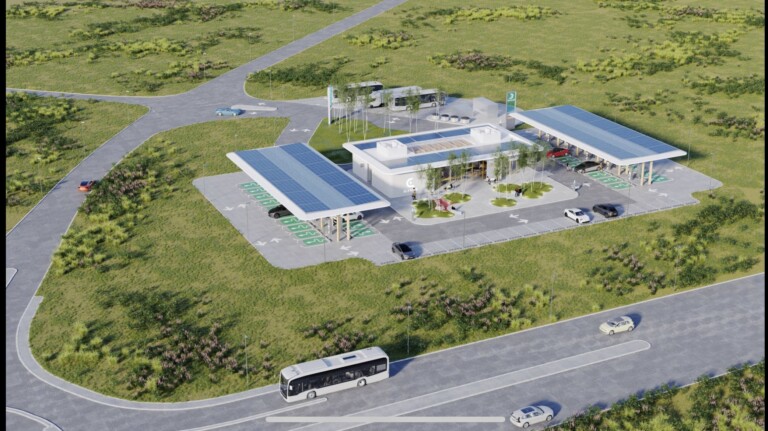
Although it is the case that much investment has been to build out and adapt existing infrastructure and incorporate fast charging within established business models alongside liquid fuels, the door has been opened to new market entrants to come into the roadside retail space and these new entrants don’t sell fuel at all.
An example of this is GRIDSERVE in the UK with its electric forecourts. In fact, next week I shall be going to see another exciting site opening in this regard in the Lithuanian market – the new partnership between El Drive and Reitan – one of Europe’s biggest convenience and supermarket retail operators. And as the pictures show, it looks spectacular and quite different.”
Conclusion
The year ahead will bring much growth in the EV industry, and with the right technology in place to support charging infrastructure, eMobility industry stakeholders will confidently grow their networks while contributing to a safe, reliable, and future-proof grid.